Skip To Product Info
1 of 2
4.8 · מבוסס על 330+ ביקורות בגוגל

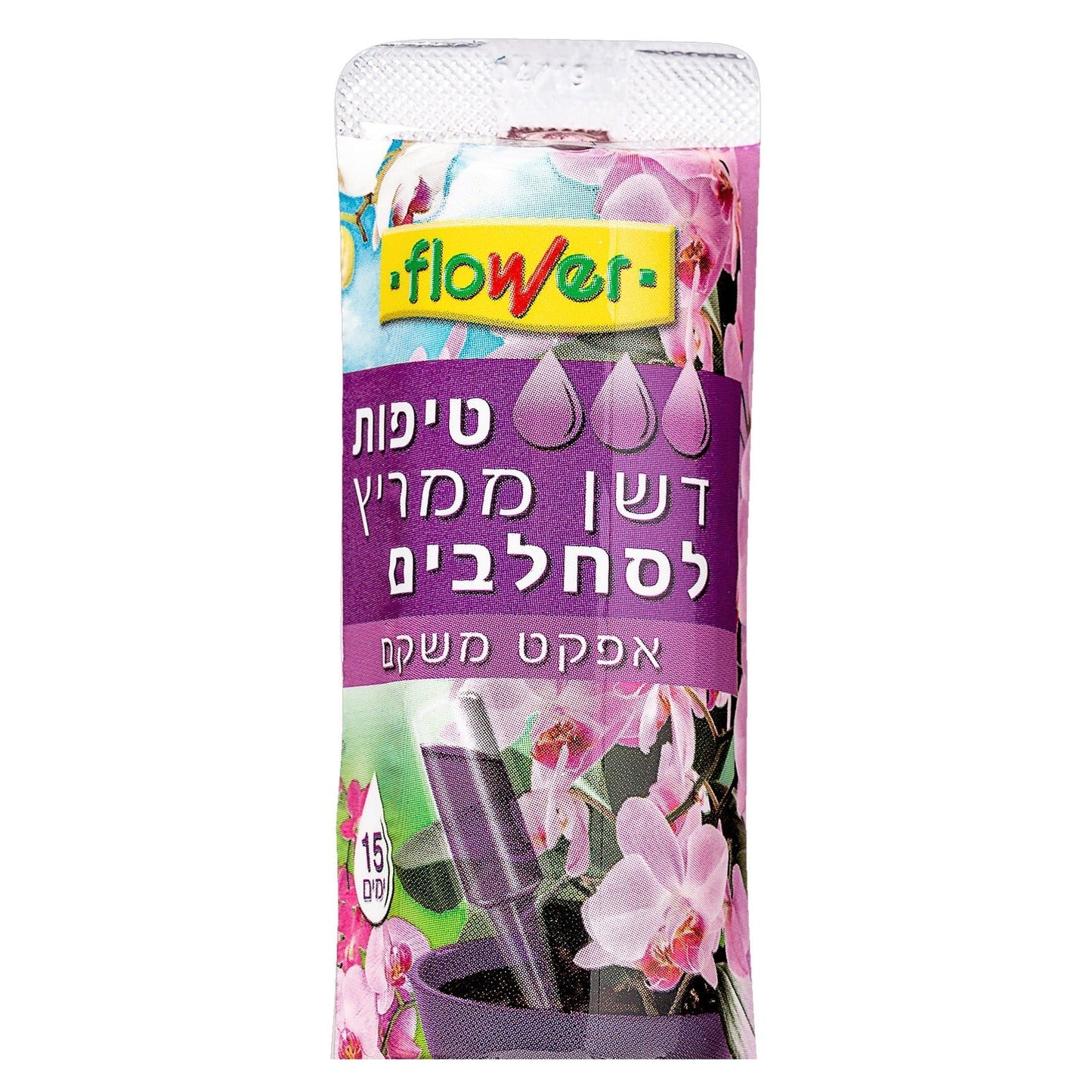
Stimulating fertilizer drops for orchids - 40 ml ampoule

Stimulating fertilizer drops for orchids - 40 ml ampoule

Regular price 12.00 ₪
Regular price Sale price 12.00 ₪
Sale Sold out
Including VAT
  • ✓ Insert into the pot and water - no measuring and no mixing
  • ✓ One ampoule nourishes the orchid for 15 days
  • ✓ Gentle dosage, just the way orchids love it
  • בקרת איכות מקצועית על כל מוצר לפני שליחתו
  • אריזה מוקפדת לבטיחות כל מוצר
  • משלוח עד הביתהאספקה מתבצעת בהתאם לאזורי החלוקה ולזמני האספקה
🔒 תשלום מאובטח📦 אריזה מוקפדת💬 ייעוץ אישי

משתלם להוסיף

Gardening gloves לעבודה נקייה בגינה
12.00 ₪
מומלץ
14.00 ₪
Spray bottleלריסוס עלים ולחות
15.00 ₪
View full details

Full product description Click for description

Volume
💧 40 ml
Single ampoule
Composition · NPK
⚗️ 0.5-0.5-0.5
+ Vitamin K3 & micro-elements
Duration
⏳ 15 days
then replace ampoule
Intended for
🌸 Orchids
Dedicated, not general
Usage
📌 Stick in pot
No measuring or mixing
Suitable for pot
🪴 20-30 cm
pot diameter

The simplest way to feed an orchid. 💜 Ready-to-use liquid fertilizer ampoule, no measuring or mixing: cut the tip, stick the ampoule into the soil near the plant, and water. The fertilizer is released to the roots gradually, nourishing the orchid for 15 days while keeping the root area moist. One 40 ml ampoule is designed for a pot with a 20-30 cm diameter. Made by Flower, Spain. 🌸

How it works - 3 steps

1
Cut
Use scissors to cut the tip of the ampoule exactly along the marked line
2
Insert
Insert the ampoule diagonally into the soil, 5-6 cm from the plant's stem
3
Water
Water the orchid as usual. Repeat the treatment every 15 days
🌱 Why orchids require fertilizer (more than any other houseplant)

An orchid does not grow in soil. It grows in an inert medium - pine bark, sphagnum moss, leca - a medium whose sole purpose is to grip the roots and provide them with air. Unlike garden soil, this medium contains almost no nutrients.

The meaning is simple: whatever you don't provide to the orchid, it won't receive. An orchid that isn't fertilized doesn't "manage on its own" - it simply stops producing new leaves, the roots weaken, and most importantly: it stops producing new flower spikes. This is the exact explanation for an orchid that bloomed once in the store and has just been sitting there green ever since.

The manufacturer defines this product precisely as: a fertilizer developed for orchids growing in inert or neutral media, lacking nutrition, which require balanced and continuous fertilization.
⚗️ Why is the NPK so low? (It's intentional)

If you compared it to other fertilizers and saw NPK 7-7-7 versus 0.5-0.5-0.5 - it is not a mistake and it is not a "weak fertilizer." That is exactly the point.

Orchids are damaged by concentrated fertilizer. This is the first rule in orchid growing, and it is repeated by every professional organization: the Missouri Botanical Garden writes that orchids "are damaged by high concentrations of fertilizer" and recommends diluting regular fertilizer to half or even a quarter of the dosage; the British RHS writes that "overfeeding can do more harm than good"; and the American Orchid Society summarizes this with the famous rule of thumb - "weakly, weekly": a weak dose, frequently.

💡 This is exactly the work the ampoule does for you: a pre-diluted dose that is released slowly over 15 days - "weakly, weekly" - without you having to dilute, measure, or calculate, and without the risk of burning roots with a dose that is too strong.

The manufacturer itself defines the product as a nutritional supplement rather than a concentrated fertilizer - and this is an accurate definition.

📋 Full usage instructions

One ampoule (40 ml) is designed for a pot with a 20-30 cm diameter.

  • 1. Cutting: Cut the tip of the ampoule with scissors, along the line marked on the packaging
  • 2. Insertion: Insert the ampoule into the medium diagonally, at a distance of 5-6 cm from the plant's stem
  • 3. Watering: Water the plant immediately afterward

🔁 How often? For optimal results, repeat the treatment every 15 days. Leave the ampoule inserted until replacement - it drains gradually into the medium.

🪴 Smaller pot? In a pot smaller than 20 cm, there is no need for a whole ampoule every 15 days - you can extend the interval between treatments.

🌸 Which orchids is this suitable for

Suitable for fertilizing all types of potted orchids. Varieties explicitly mentioned by the manufacturer:

  • 🌸 Phalaenopsis: "Butterfly Orchid" - the most common orchid in homes
  • 🌷 Cattleya: Large and fragrant flowers
  • 💛 Cymbidium: Blooms in winter, flowers are long-lasting
  • 👞 Paphiopedilum: "Lady's Slipper," a flower with an inflated lip

Please note: This is a dedicated orchid fertilizer. For other houseplants, a general fertilizer is preferable.

🤔 Ampoule or fertilizer bottle? What suits you

Both methods are good - the question is how many orchids you have and how much you want to deal with it:

  • 📌 The Ampoule (this product): Ready-made single dose, no measuring or mixing. Perfect for one or two orchids, for those who don't want to get involved, and for those who just want to try it out cheaply.
  • 🧴 Orchid Fertilizer 300 ml: Bottle with a measuring cap that you dilute in water. More cost-effective in the long run and for an orchid collection, but requires measuring and dilution for every watering.

Many people start with the ampoule and move to the bottle when the collection grows. 🌸

💡 Tips for an orchid that will bloom again
  • 💧 Not on a completely dry medium: Fertilize after watering or on a moist medium - fertilizer on a dry medium can burn roots
  • 🌱 Crucial during the growing season: The orchid needs nutrition the most when it is producing a new leaf, a new root, or a flower spike
  • 😴 Less in winter: Phalaenopsis continues to grow in winter and it is worth continuing to nourish, but at a lower rate
  • 💦 Flush once a month: Fertilizers are salts that accumulate in the medium. Once a month, water with clean water only - this flushes out excess salts
  • 🚫 Keep distance from the stem: 5-6 cm. Inserting right next to the plant can damage the roots
  • 🪟 Fertilizer does not replace light: An orchid needs bright, filtered light. Without enough light, no fertilizer will produce blooms
⚠️ Safety and storage
  • 👶 Children: Keep out of reach of children
  • 🚫 Not for ingestion: The product is not intended for consumption
  • 🍽️ Food: Keep away from food, drink, and edible items
  • 📦 Storage: Store in a cool, dry, and clean place
  • ✂️ Single-use: The ampoule is intended for one-time use - insert and leave until replacement

Information is based on the manufacturer's instructions appearing on the packaging.

📋 Technical specifications
  • Product Name: Stimulating Orchid Fertilizer Drops (restorative effect)
  • Type: Liquid nutritional supplement in an ampoule for insertion into the pot
  • Volume: 40 ml (one ampoule, single dose)
  • Composition: NPK 0.5-0.5-0.5 + Vitamin K3 & micro-elements
  • Vitamin K3: According to the manufacturer, contributes to maintaining good flowering and enhancing the natural color of the flowers
  • pH: According to the manufacturer, contributes to maintaining a slightly acidic medium - the recommended range for most orchids
  • Intended for: Potted orchids
  • Suitable for pot: 20-30 cm diameter
  • Duration: 15 days per ampoule
  • How to use: Cut the tip, insert diagonally 5-6 cm from the stem, and water.
  • Brand: Flower
  • Manufacturer: Productos Flower S.A., Spain 🇪🇸
  • Manufacturer SKU: 10863
  • Import and Marketing: Dorgan Ltd.
  • Barcode: 8426584108635
🌸💧✨

Cut, insert, water – and the orchid is fed for 15 days.

💡
Nursery Tip

Fertilizer is half the story - the potting medium is the other half. An orchid sitting in compacted garden soil will have its roots choked, and even the best fertilizer won't save it. An orchid needs an airy medium that allows the roots to breathe, and preferably a transparent pot - so that the roots get light and you can see when they are thirsty. If your medium is old and crumbling, it is worth replacing it with pine bark-based orchid mix. The combination of the right medium, the right light, and regular feeding is what makes an orchid bloom again. 🌸

❓ Frequently Asked Questions

❓ How do I use an orchid ampoule?

Cut the tip of the ampoule at the marked line, insert it diagonally into the medium 5-6 cm from the stem, and water the orchid as usual.

❓ Why does an orchid need regular fertilization?

Because an orchid grows in an inert medium like pine bark, sphagnum, or leca, which has almost no food in it itself - all of its nutrition comes from fertilization.

❓ Why does an orchid need gentle fertilizer?

Orchid roots are sensitive to concentrated fertilizer, so weak and frequent fertilization is preferred. The ampoule releases the fertilizer gradually.

❓ How long does one ampoule last?

About 15 days; then replace with a new ampoule.

❓ Is it suitable for all types of orchids?

Yes, including Phalaenopsis, Cattleya, Cymbidium, and Paphiopedilum - general fertilization for potted orchids.

❓ Ampoule or fertilizer bottle - which is more suitable?

An ampoule is suitable for one or two orchids without measuring or mixing; a bottle is more cost-effective for a large collection but requires dilution with every watering.

❓ Do you have a tip for an orchid that won't bloom?

Alongside fertilization, it is important to have bright, filtered light and an airy medium - without these, even good fertilization won't lead to new blooms.

📖

Want to learn more? The complete guide to orchids

Everything you need to know about caring for the plant - light, watering, fertilization, and common problems - in one guide.

Read the full guide ←

📘 Another useful guide: How to care for and repot a Phalaenopsis orchid

With over 330 Google reviews and a 4.8⭐ rating – you’re in good hands. ♥️