

How to care for and repot a Phalaenopsis orchid: watering, potting medium, and size
 המוצר מהמדריך זמין באתר
White Phalaenopsis orchid in a 12 cm ceramic pot
200.00 ₪
Deco Garden Practical Guide
A Phalaenopsis orchid does not need a rigid watering schedule or a large pot "for room to grow." It needs appropriate light, well-aerated medium, full drainage, and a pot sized for its root ball. Here, we measure before we buy and act according to the plant's needs.
Before care: Identifying what is truly in front of us
The plant in the product photos is a white orchid with the typical Phalaenopsis structure. Most Phalaenopsis orchids sold as houseplants are hybrids without a specific cultivar name. Therefore, this guide addresses the domestic Phalaenopsis, but does not invent a cultivar name, a fixed blooming period, or a trait not found on the plant's label.
Watering: Check the medium, not the day of the week
Do not water on a fixed day. The drying rate changes according to the season, light, temperature, pot size, and medium type. Water when the medium is almost dry and the pot feels lighter, but before the roots remain completely dry for a prolonged period.
- Observe: In a clear pot, moist roots generally look greener and drying roots look silver. This is a helper sign, not a sole moisture gauge.
- Lift: Compare the weight of the pot after watering to its weight when the medium approaches dryness.
- Water thoroughly: Evenly moisten the medium with lukewarm water and allow the excess to drain out from all drainage holes.
- Empty: Do not leave standing water at the bottom of the ceramic pot, and do not leave water in the center of the leaf rosette.
The transparency allows you to see if the medium is still moist and to check the condition of the roots. It does not replace drainage holes, aerated medium, and full drainage after every watering.
Pot size: Measure the root ball after cleaning
Phalaenopsis prefers a relatively small container. After removing old medium and dead roots, choose the smallest pot that comfortably holds the healthy root ball. According to American Orchid Society guidelines, leave approximately 1.3–1.9 cm around the root ball for future growth. Do not choose based on leaf span or bloom spike height.
| Commercial size | When it is a suitable candidate | When not to choose it |
|---|---|---|
| 12 cm | For a compact root ball that already fits comfortably with only a small gap. | Do not upgrade just because the plant is tall or blooming. |
| 15 cm | A natural candidate after a 12 cm pot, only if the healthy root ball is too crowded in the smaller pot. | Do not automatically transfer a new plant or one at the peak of bloom. |
| 18 cm | For extensive roots that do not fit in 15 cm with the required gap. | Not suitable for a small root ball; excess medium stays wet for too long. |
| 24 cm | Only for a very large plant with a healthy, extensive root mass that has been physically measured. | Not a "future pot" for an average plant; excess volume increases drying time. |
12, 15, 18, and 24 cm are the commercial sizes appearing in the product selector. Internal diameter, external diameter, and height are not necessarily identical to the commercial number. If the pot needs to fit into a decorative container precisely, ask us for a measurement of the available variant before ordering.
Proper transfer essentials — not an automatic purchase
When to repot — and how to do it without burying the plant
Repot when the medium breaks down and stays wet too long, when healthy roots no longer fit in the pot, or when there is a root issue requiring attention. When the plant is healthy, a convenient time is after blooming and at the start of new root growth. If there is active rot, do not wait for a "correct" date.
- Prepare: A clean pot with drainage holes, fresh orchid medium, and clean cutting tools.
- Remove gently: Loosen the pot and press on it instead of pulling the plant by the bloom spike.
- Clean and inspect: Remove old medium. A healthy root is usually firm; a dead or rotten root may be hollow, soft, or brown. Trim only dead or rotten tissue.
- Measure: Check the width of the remaining root ball and select the smallest container that leaves limited space for growth.
- Position: The base of the leaves remains above the surface of the medium. Do not bury the crown and do not force healthy air roots into the pot.
- Fill and stabilize: Insert medium between the roots without packing into a dense mass. The plant should be stable, and water must flow freely.
Fertilizing: Little, measured, and on moist medium
Use dedicated orchid fertilizer according to the label on the bottle. Do not guess dosage from a picture and do not exceed it. Fertilize when the plant is in active growth and on medium that is already slightly moist; excess fertilizer can accumulate as salts and damage the roots.
The formula and dosage can change between models and batches. The packaging you hold determines it.
The RHS recommends watering with plain water every fourth watering to reduce salt buildup in the medium.
During a cool or dark period, the plant uses less water and fertilizer. Adjust the rate to the plant's state and the label.
Frequently asked questions
Looking for a white orchid ready as a gift?
On the product page, you will see the plant, the ceramic pot, and gift-wrapping options. A living plant may vary slightly from plant to plant.
For a white Phalaenopsis orchid🛒 המוצרים מהמדריך
הצמחים והמוצרים שהמדריך מדבר עליהם — לחיצה על כרטיס מעבירה לעמוד המוצר.
-
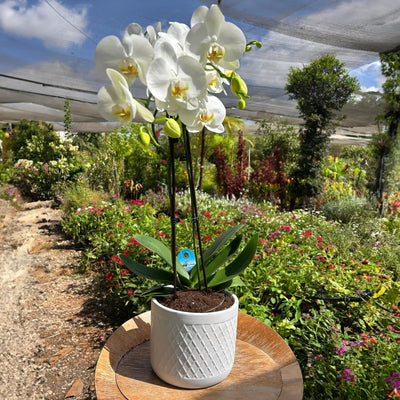 White Phalaenopsis orchid in a 12 cm ceramic pot
200.00 ₪לעמוד המוצר
-
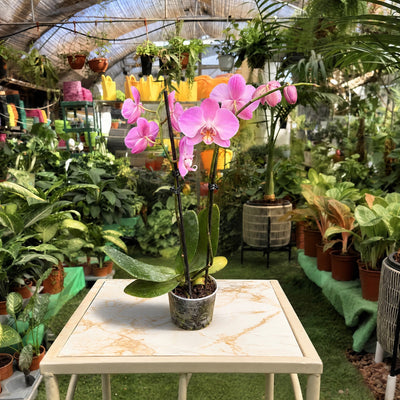 Phalaenopsis orchid 2 stems, pot diameter 15 cm
190.00 ₪לעמוד המוצר
-
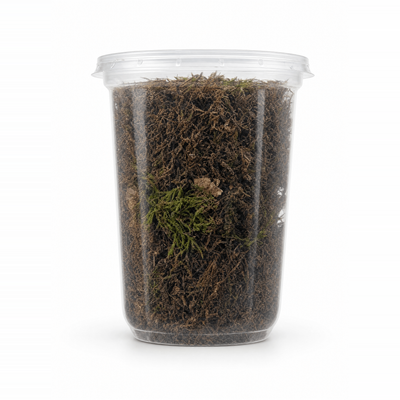 Live Sphagnum Moss (dormant) – Long-fiber mat for terrariums, orchids, and exotic plants
18.00 ₪לעמוד המוצר
-
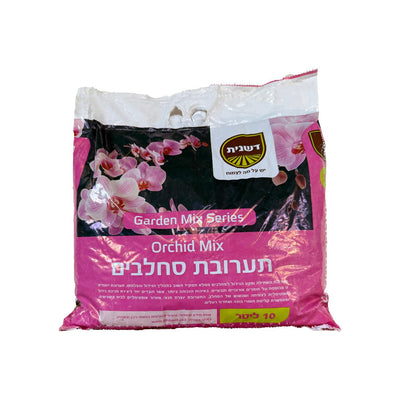 Orchid potting mix – nutrient-rich orchid blend, 1 or 10 liters
החל מ-12.90 ₪לעמוד המוצר
-
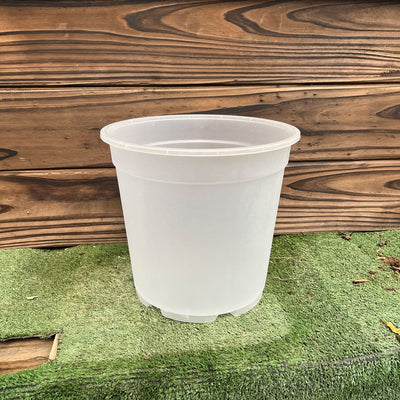 Transparent orchid pot
החל מ-6.00 ₪לעמוד המוצר
-
 Flower Liquid Fertilizer for Orchids – 300 ml
28.00 ₪לעמוד המוצר
-
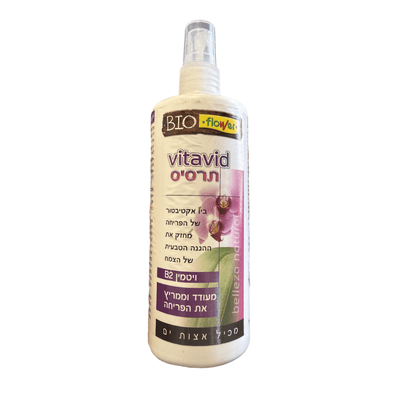 Vitawide spray for promoting blooming and foliar feeding for orchids and houseplants 180 ml
34.90 ₪לעמוד המוצר
-
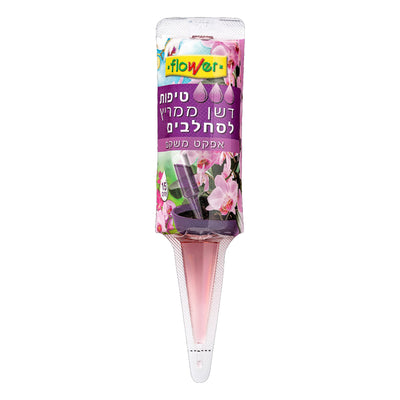 Stimulating fertilizer drops for orchids - 40 ml ampoule
12.00 ₪לעמוד המוצר

