🌵 Yucca | The Complete Guide to Growing and Care
 המוצר מהמדריך זמין באתר
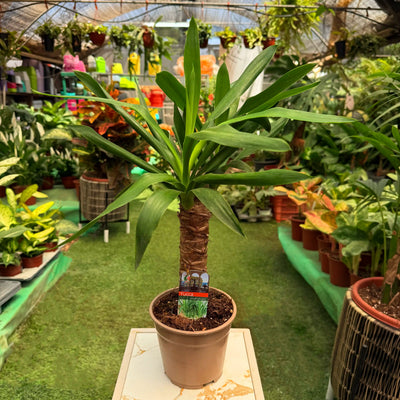
Yucca on a trunk, 14 cm pot diameter
105.00 ₪
המוצר מהמדריך זמין באתר
Yucca on a trunk, 14 cm pot diameter
105.00 ₪
📋 Quick Summary - Everything you need to know at a glance
The Yucca cane is the easiest "palm-like" indoor plant to grow: it loves the sun, requires very little water, and forgives neglect. There is only one thing important to remember - do not overwater.
Full to partial sun
Loves direct sun too
Very sparse
Only when soil is dry deep down
Very easy!
Resistant to neglect
Ornamental cane tree
Drought tolerant
1-2 m in a pot
Up to 8-10 m in nature
🌱 Getting to know the plant
Names and Identification
- Hebrew name: Yucca / Yucca on a cane / Giant Yucca
- Scientific name: Yucca gigantea (Common synonym: Yucca elephantipes)
- English: Spineless Yucca / Giant Yucca / Yucca Cane
- Family: Asparagaceae
- Type: Cane tree/shrub, drought tolerant
Origin and Background
The Yucca originates from Mexico and Central America (up to Guatemala), where it grows as a tall tree in strong sun and well-drained soil. This is the only Yucca species that thrives indoors because, unlike its family members, its leaf tips are relatively soft and not sharp. In Hebrew, it is also known as "Yucca on a cane" due to the thick trunk from which green umbrellas of leaves emerge.
Unique Characteristics
- 🌵 Highly drought tolerant - stores water in the trunk and roots
- ☀️ Loves strong light - handles even full direct sun
- 💪 Forgiving of neglect - forget to water? It will only thank you
- 🌳 "Palm tree" look indoors - upright architectural silhouette
- 🏡 Indoor and outdoor - also suitable for a sunny balcony
- ⚠️ Slightly sharp leaf tips - place away from walkways and at eye level for children
🔎 Note - What is the Yucca confused with?
- Yucca gigantea vs. elephantipes: The exact same plant. Yucca gigantea is the current valid botanical name, and elephantipes is an old synonym still common in the market.
- Vs. Dracaena: Dracaena is also sold "on a cane" with a bundle of leaves, but Yucca leaves are stiffer, upright, and pointier.
💚 Why choose a Yucca?
Weeks without water - and it's perfectly fine
South-facing window or a sunny balcony
Fills an empty corner with height
Sturdy green foliage all year round
Cane cuttings take root almost always
Moves to the balcony in the summer without issues
🌿 Varieties and common forms
Single-headed Yucca cane
A single trunk with one umbrella of leaves. The classic - clean and upright.
Multi-cane Yucca (tiered)
Multiple trunks at different heights in the same pot - a full "palm tree" look.
Variegated variety (Variegata)
Leaves with cream/yellow stripes on the edges. Particularly beautiful, slightly more sensitive to strong sun.
All forms are cared for the same way - strong light, little water, and well-drained soil.
🌤️ Detailed growth conditions
☀️ Light
- Ideal location: Full sun - this gives it upright leaves and strong growth.
- Also handles bright indirect light near a bright window, but will grow slower and with sparser foliage.
- Indoors - prefer a south or west window. A place that is too dark is the sure way to a weak plant.
- If it moved suddenly from partial shade to full direct sun - acclimate it gradually to prevent "sunburn" on the leaves.
💧 Watering (Most important!)
The Yucca is highly drought resistant. The rule: water only when the soil is dry - and deep down. Overwatering is the #1 reason for Yucca deaths (root rot).
About once every 1-2 weeks, only after the soil has dried out on top.
Very little - once every 3-4 weeks, just so the soil doesn't stay completely dry for too long.
How to know when it's time? Stick a finger inside: if the top 5 cm are completely dry - you may water. It is better to saturate well once and let excess drain, rather than little and often. Never leave water in the saucer under the pot.
🌡️ Temperature and Climate
- Comfort range: 15-26°C. Loves heat and feels great in the Israeli summer, including heatwaves and dry air.
- ⚠️ Sensitive to frost. It gets damaged below ~5°C. In warm regions (center, coastal plain, warm valleys) it can be left outside all year; in the mountains and cold areas during winter nights - bring it inside or protect it.
- In the garden, it is suitable mainly for Mediterranean/hot desert climates (in nature rated as USDA 9-10 hardy).
🌍 Soil and Pot
- Most important: Excellent drainage. Light mix - preferably cactus/succulent mix, or potting soil with added perlite/coarse sand.
- Ideal pH: between 6 and 7.5.
- Pot with drainage holes - mandatory. For a large plant, choose a deep and stable pot (20-40 liters) so it doesn't tip over.
🧪 Fertilization
Balanced liquid fertilizer about once a month. That's all it needs.
Stop fertilizing. The plant is resting and doesn't need nourishment.
Yucca is not a "heavy feeder" - better too little fertilizer than too much.
✂️ Pruning and Maintenance
- Usually no pruning needed. Simply remove dry or damaged leaves as needed.
- Too tall? You can "top" the cane at the desired height in the spring - the plant will sprout new leaf heads below the cut. You can propagate the removed cane section as a new plant!
- Wipe dust off leaves occasionally with a damp cloth - it helps the plant "breathe" and looks better.
🌱 Propagation (making a new plant)
The Yucca is among the easiest plants to propagate - cane cuttings take root almost always. The best time is in the spring.
- Cut a healthy cane section (approx. 15-20 cm) with a sharp, clean knife.
- Leave the cutting to dry (callous over) for a day or two in a shaded place - important to prevent rot.
- Plant in a light, sandy mix, ensuring the end that was at the bottom stays facing down.
- Water sparingly and keep lightly moist (not wet) until roots form - usually within a few weeks.
- You can also separate "pups" (cuttings) that grow at the base of the plant and plant them separately.
Tip: Do not overwater during the rooting stage - slight dryness is better than rot.
🔧 Common problems and solutions
🦠 Soft / Black trunk and falling leaves
Symptom: Leaves yellowing and falling, trunk becoming soft, black roots.
Cause: Overwatering and root rot - Yucca's #1 problem, especially in winter.
Solution: Stop watering immediately, remove from pot, cut away rotten roots/trunk, and repot in dry, well-draining mix.
🍂 Brown and dry leaf tips
Symptom: Leaf tips drying and brown.
Cause: Usually very dry air/prolonged dryness, sometimes excess salts/fertilizer.
Solution: Water more regularly (but let the soil dry between waterings), and flush the soil occasionally to remove salts.
📉 Stretching trunk and pale leaves
Symptom: Leggy and weak growth, pale color.
Cause: Too little light.
Solution: Move to the brightest spot in the house - south-facing window or sunny balcony.
🌫️ Leaves losing luster
Symptom: Dusty and dull foliage.
Cause: Dust accumulation.
Solution: Gently wipe with a damp cloth every few weeks.
🐛 Pests to watch out for
- Scale/Aphids: Sticky spots or small "shields" on the trunk and leaves - wipe with alcohol/soapy water.
- Spider Mites (webbing): Appears in dry and hot air - thin webs and light dots. Rinse well and increase humidity.
- Snails and slugs: Relevant mainly when the plant is outside - may chew leaves.
❓ FAQ
Very rarely. In the summer, about once every week or two, and only after the soil has dried out on top; in the winter, once every 3-4 weeks. Always better to wait for the soil to dry out than to water "just in case".
The most common cause is overwatering and root rot. Stop watering, ensure the soil drains, and if necessary, switch to a dry, well-draining mix.
Yes, it actually loves it - full sun gives it the strongest growth. Only when moving it abruptly from a shaded place to strong sun should you acclimate it gradually.
In warm areas of Israel - yes. But the Yucca is sensitive to frost, so in mountains and areas where nights drop below ~5°C, it's best to bring it inside or protect it.
Cut a healthy cane section in the spring, let the cut dry for a day or two, and plant in a lightly moist sandy mix. Within a few weeks, roots will form.
📊 Summary Table
| Category | Details |
|---|---|
| ☀️ Light | Full to partial sun; also does well in direct sun. Very bright location. |
| 💧 Watering | Very sparse. Only when the soil is dry deep down. Summer: ~once every week or two, Winter: once every 3-4 weeks. |
| 🌡️ Temperature | 15-26°C. Loves heat; sensitive to frost (below ~5°C). |
| 💦 Humidity | Low-medium. Suitable for Israel's dry air. |
| 🌍 Soil | Light and very well-drained (cactus mix/perlite). pH 6-7.5. |
| 🧪 Fertilization | Balanced fertilizer once a month in spring-summer; stop in winter. |
| 📏 Size | 1-2m in a pot; in the wild up to 8-10m. |
| 📊 Difficulty Level | Very easy; resistant to neglect. The only danger - overwatering. |
| ✨ Special | The only Yucca convenient for indoor growing; "tree" look at home; easy to propagate. |
🛒 Shop at Deco Garden
Nationwide home delivery. Updated prices on the website.
🌿 Deco Garden - A Love for Plants
A beautiful and healthy Yucca starts with the right choice - and we are here for that. Have a question about your plant? Write to us and we'll be happy to help.
📧 info@decogarden.co.il | 🌐 decogarden.co.il
© 2026 Deco Garden - All rights reserved
The guide was written by the Deco Garden expert team
🛒 המוצרים מהמדריך
הצמחים והמוצרים שהמדריך מדבר עליהם — לחיצה על כרטיס מעבירה לעמוד המוצר.