

🌿 Foliage Begonias (Rex, Angel Wing, and more) | The Complete Guide
 המוצר מהמדריך זמין באתר
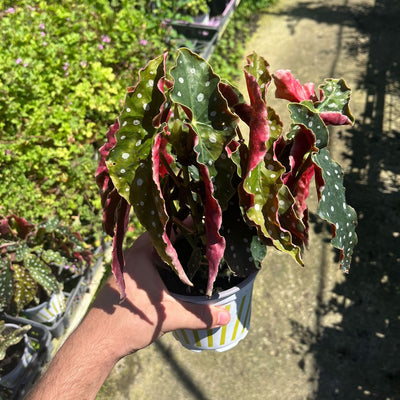
Begonia from Colta, pot diameter 12 cm (perennial for the house)
48.00 ₪
📋 Quick Summary - Everything you need to know at a glance
Bright, indirect
No direct sun
Moderate
Top 2-3 cm should be dry before watering again
Moderate
Easy with a little attention
Foliage Begonias
Cane / Rhizomatous (not Rex)
Approx. 20 to 100 cm
Depends on the variety
🌱 Introduction to the plant
Names and Identification
- Hebrew Name: Foliage Begonias (Begonia)
- Scientific Name: Begonia spp. - Cane and Rhizomatous varieties
- English: Foliage / Cane / Angel Wing / Rhizomatous Begonias
- Family: Begoniaceae
- Type: Herbaceous perennial, sometimes epiphytic
Origin and Background
The Begonia genus includes about 1,500 species of plants originating from moist tropical and subtropical regions in South and Central America, Africa, and Southern Asia. From this vast family, thousands of varieties and hybrids have evolved - some grown primarily for their flowers (like the flowering Begonia / Semperflorens), and some, like those in this guide, are grown primarily for their spectacular foliage: Cane varieties (with bamboo-like stems, such as Angel Wing and Mauricei) and rhizomatous varieties (with a creeping underground stem, such as Masoniana and Escargot). In Israel, foliage begonias are very common as ornamental plants in homes, offices, and shaded gardens.
Unique Characteristics
- 🎨 Asymmetrical leaves - each leaf is "crooked" in a characteristic way, often with patterns, spots, or a metallic sheen
- 🌸 Unisexual flowers - separate male and female flowers on the same plant, usually pink, red, white, or yellow
- 🪴 Thick root system - rhizomes, underground tubers, or succulent stems that store water
- 🎋 Bamboo-like stems (in Cane varieties) - with clear nodes along the stem
⚠️ Do not confuse with Rex Begonia
This guide covers the "other" foliage begonias - Maculata, Angel Wing, Mauricei, Masoniana, Escargot, and Black Coffee - all of which are relatively easy to grow and develop quickly from stem cuttings. Rex Begonia, which has even more dramatic colorful foliage but higher requirements for humidity and sensitivity, has its own separate care guide: 👑 The complete guide to Rex Begonia.
💚 Why choose a foliage begonia
🌿 Varieties grown by Deco Garden
🦋 Angel Wing
The classic variety family - bamboo-like stems with prominent nodes and wing-shaped asymmetrical leaves. They bloom in hanging clusters throughout much of the year and come in green, spotted, and metallic shades.
💗 Mauricei
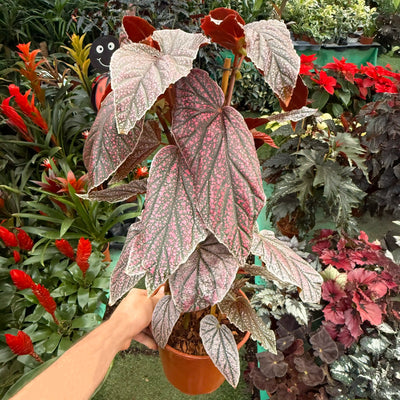
A cane variety with metallic-pink foliage and silver dots - the brighter the light (while still indirect), the more prominent the pink in the leaves. It grows fast and reaches up to a meter in height.
✝️ Masoniana - Iron Cross (Begonia masoniana)
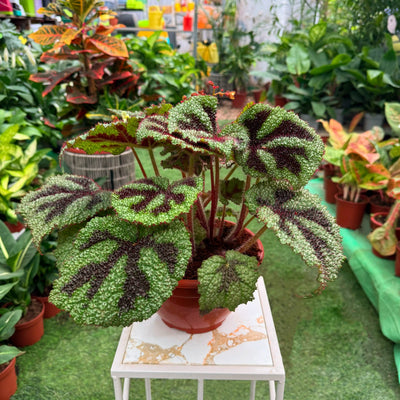
A rhizomatous variety with rough, bubbly green leaves, with a brownish-red Iron Cross pattern in the center. Low and wide growth, without a prominent cane stem.
🐌 Escargot
A rhizomatous variety with a mesmerizing spiral pattern on the leaf - rings of dark green and silver that open towards the center of the leaf like a snail shell.
☕ Black Coffee
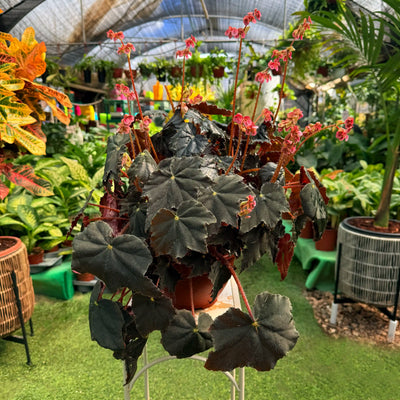
A cane variety with dark, almost black-bronze and glossy foliage, providing a beautiful contrast to the pinkish-white flower clusters. A dramatic addition to any plant collection.
🌤️ Detailed growing conditions
☀️ Light
- Bright indirect light throughout most of the day - near an east or west window, not touching the glass
- Strong direct sun (especially noon in the Israeli summer) can burn the leaves and fade the pattern of spots and colors
- The brighter the light (while still indirect) - the more intense the color will be in metallic-pink varieties like Mauricei
- In Israel: In summer, keep away from a south/west window with direct sun; in winter, you can move it closer to light
💧 Watering
Let the top 2-3 cm of soil dry out between waterings. Water thoroughly until water drips from the drainage holes, and always empty the saucer - foliage begonias, and especially Cane varieties, are particularly sensitive to overwatering and root/stem rot.
Check about every 4-6 days
Interval grows significantly - check every 10-14 days
How to tell: Insert a finger 2-3 cm into the soil - if it's dry, it's time to water. Limp leaves can indicate both overwatering and underwatering, so always check the soil itself first.
🌡️ Temperature
Comfort range: about 18-27°C. These are tropical plants that do not tolerate cold - temperatures below 13°C can harm them.
⚠️ Frost warning: In Israel, in mountain and valley areas (Jerusalem, Upper Galilee), grow them indoors or in a heated greenhouse in winter - do not leave them outside on cold nights.
💦 Humidity
- Foliage begonias love relatively high humidity (about 60-75%) - but you must not get the leaves themselves wet
- Water left on leaves combined with poor ventilation are ideal conditions for powdery mildew and Botrytis (gray mold)
- Prefer a gravel tray with water, a humidifier, or grouping plants together - rather than direct misting on the foliage
- The air-conditioned Israeli home in summer and heated in winter dries the air - be especially careful during these seasons
🌍 Soil
- A mix rich in organic matter, well-drained, with an acidic-neutral pH (about 5.5 to 6.5)
- Good mix: quality potting soil + perlite or coarse sand + compost, in a ratio that ensures fast drainage
- A pot with drainage holes is a must - insufficient drainage is the number one cause of rot
🌱 Fertilization
Balanced liquid fertilizer, diluted according to the package instructions, about every 2-4 weeks during the active growth season
Significantly reduce or stop completely - the plant is in relative dormancy and the growth rate is slow
Foliage begonias are not "heavy feeders" - excess fertilizer can burn roots more than it will help the plant.
✂️ Pruning and Maintenance
🌿 Propagation
- Choose a healthy stem about 8-10 cm long with 2-3 leaf nodes
- Remove the lower leaves and leave only the top ones
- Plant in a well-drained mix (perlite/vermiculite) - or simply place in a glass of water
- Keep moisture constant (or change the water every few days) in a location with bright indirect light and warmth
- Roots usually develop within a few weeks; after they have developed enough, you can transfer to a permanent pot
This is one of the easiest and most reliable methods for propagating houseplants - no special equipment is needed, and it's the fastest way to double your collection without buying another pot.
🔧 Common problems and solutions
🥀 Soft and rotting stems
Symptom: Soft, brown, and "watery" stem.
Cause: Overwatering or poor drainage.
Solution: Remove from the pot, prune rotting parts, repot in fresh dry soil, and reduce watering.
⚪ White powder on leaves
Symptom: Grayish-white coating on the leaves.
Cause: Powdery mildew - moisture on leaves combined with poor ventilation.
Solution: Stop wetting leaves, improve ventilation, remove infected leaves.
🌫️ Gray mold on stems and flowers
Symptom: Soft grayish mold (Botrytis).
Cause: High humidity combined with poor airflow.
Solution: Remove infected parts, improve airflow, avoid wetting the foliage.
🎨 Fading color and spots on leaves
Symptom: The spots/colors fade, the leaf turns pale.
Cause: Too much direct sun.
Solution: Move to a location with more indirect light.
🌾 Tall and sparse plant ("leggy")
Symptom: Long stems with few leaves.
Cause: Insufficient light and lack of pinching.
Solution: Move to a brighter location and pinch young stem tips.
🐛 Pests
Common pests: Mealybugs (clean manually with a swab dipped in alcohol), mites (spider mites) - cause yellow dots on leaves, whitefly - can be eradicated by a strong spray of water and neem oil, and thrips, which can also carry viruses that cause leaf distortion and fading. In all cases - isolating the infested plant and treating with insecticidal soap or neem oil is usually enough.
❓ Frequently asked questions
Usually, this is a sign of excessive exposure to direct sun. Foliage begonias need bright but indirect light - strong sun burns the leaves and fades their pattern.
There is no fixed interval - check the soil. Water when the top 2-3 cm are dry to the touch, usually every few days in summer and every 10-14 days in winter. Overwatering is more dangerous than underwatering.
This is likely powdery mildew, which develops when wet leaves are combined with poor ventilation. Avoid wetting the foliage when watering, improve air circulation, and remove infected leaves.
Cut a stem about 8-10 cm long with 2-3 nodes, remove the lower leaves, and root it in water or a well-draining mix. Roots usually develop within a few weeks.
Both are begonias with spectacular foliage, but the Rex begonia (Begonia Rex) is a separate group with particularly high humidity requirements and greater sensitivity. It has a separate care guide on the site - read here.
📊 Summary Table
| Category | Details |
|---|---|
| ☀️ Light | Bright, indirect light; no direct sun |
| 💧 Watering | When the top 2-3 cm are dry; do not leave standing in water |
| 🌡️ Temperature | Approx. 18-27°C, not below 13°C |
| 💦 Humidity | High (60-75%) - without getting the leaves wet |
| 🌍 Soil | Rich, well-draining, pH 5.5-6.5 |
| 🌱 Fertilizing | Balanced and diluted, every 2-4 weeks in spring-summer; stop in winter |
| 📏 Size | About 20 to 100 cm, depending on variety |
| 📊 Difficulty Level | Moderate |
| ✨ Special | Regular pinching of cane varieties prevents them from becoming "leggy" and maintains a bushy shape |
🌿 Deco Garden - A Love for Plants
Do you have a question about your foliage begonia? The Deco Garden team is here for you - in the store and on the website.
© 2026 Deco Garden - All rights reserved
The guide was written by the Deco Garden expert team
🛒 המוצרים מהמדריך
הצמחים והמוצרים שהמדריך מדבר עליהם — לחיצה על כרטיס מעבירה לעמוד המוצר.
-
 Begonia from Colta, pot diameter 12 cm (perennial for the house)
48.00 ₪לעמוד המוצר
-
 Begonia Mauritzi Pot 15 cm
75.00 ₪לעמוד המוצר
-
 Begonia soli-mutata, 20 cm pot diameter
75.00 ₪לעמוד המוצר
-
 Begonia Black Coffee 20 cm pot diameter
75.00 ₪לעמוד המוצר
-
 Begonia Escargot, 20 cm pot diameter
90.00 ₪לעמוד המוצר
-
 Begonia King Solomon Midnight Shadow, 20 cm pot diameter
75.00 ₪לעמוד המוצר
-
 Begonia masoniana, 20 cm pot diameter
90.00 ₪אזל כרגעלעמוד המוצר
-
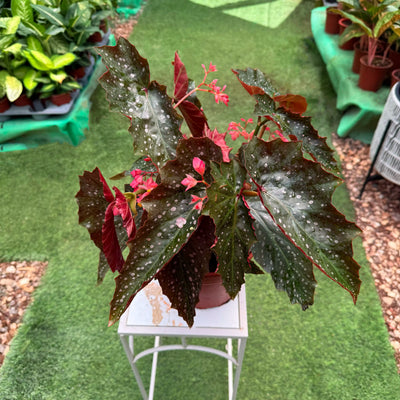 Polka Dot Angel Wing Begonia 3-liter pot
80.00 ₪לעמוד המוצר


