How to choose a watering can: volume, weight, and proper watering for potted plants
 המוצר מהמדריך זמין באתר
funnel
18.00 ₪
המוצר מהמדריך זמין באתר
funnel
18.00 ₪
Deco Garden Practical Watering Guide
A large watering can saves refills, but also becomes heavy. A small one is easy to control, but requires more trips to the tap. This guide helps you choose between 1, 3, 5, and 8-liter sizes, check if your plant actually needs water, and water the substrate without leaving the roots in excess.
The watering can doesn't dictate the schedule — the plant and substrate do
There is no single schedule that works for all potted plants. The plant type, container size, container material, substrate, light levels, heat, wind, and humidity all change the drying rate. That is why you check the state of the substrate before filling the watering can, rather than watering just because it’s a set day of the week.
For many houseplants, you can start by checking the substrate with your finger and by the weight of the pot: dry substrate feels lighter. This is not a uniform instruction for every species. Cacti and succulents, orchids, ferns, and young plants may require different checks, so match your decision to the specific guide for that plant.
Choosing volume: how much weight are you comfortable carrying?
One liter of water weighs approximately one kilogram. To this, add the weight of the watering can itself. An 8-liter can, when full, carries about 8 kg of water, excluding the weight of the can; you are not required to fill it to the top. The RHS recommends filling a can to a weight you are comfortable carrying and making an extra trip instead of struggling with a heavy vessel.
The number on the can indicates its capacity, not the dose for a plant. The amount of water for each pot is determined by the volume of the substrate, the level of dryness, the type of plant, and the drainage. A large can does not mean you pour more on every pot.
| Marked Capacity | Water weight when full | Practical starting point |
|---|---|---|
| 1 Liter | Approx. 1 kg, plus can weight | Easy to control for a few small pots in tight indoor spaces. |
| 3 Liters | Approx. 3 kg, plus can weight | A compromise between weight and number of refills for house or balcony routines. |
| 5 Liters | Approx. 5 kg, plus can weight | Fewer refills for larger collections, if the weight is comfortable for lifting and pouring. |
| 8 Liters | Approx. 8 kg, plus can weight | For a longer sequence of pots; can be partially filled to maintain control. |
The table compares only the water mass. It does not measure the weight of the can, its dimensions, or the number of pots that can be watered from it. These data points depend on the product and the amount each pot needs that day.
Looking to choose a volume and color?
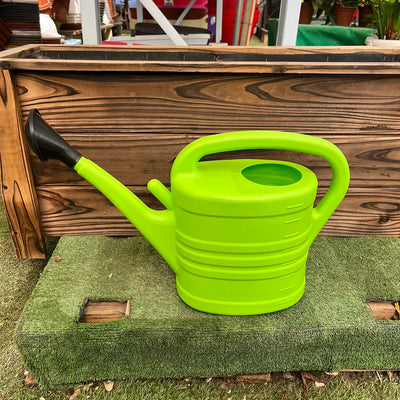
On the watering can page, you will find capacities of 1, 3, 5, and 8 liters available in red, green, and yellow. Choose based on a comfortable carrying weight, not on a promise of a fixed number of pots.
Select a watering canHow to water a pot with a watering can
- Check before pouring: Touch the substrate at a depth appropriate for the plant and check if the pot has become lighter. If it is still wet, wait.
- Fill to a comfortable weight: No need to use the full capacity. Keep control over the handle and spout even when moving between pots.
- Aim for the substrate: Pour slowly and close to the substrate surface, around the root zone, and avoid rinsing the leaves. A slow pour reduces water runoff and substrate displacement.
- Stop when drainage begins: In a pot with holes, allow excess water to escape. Substrate that has dried significantly and pulled away from the sides of the pot may require a few small pours in short intervals to be wetted evenly.
- Empty excess water: Empty the saucer or cachepot and do not leave the bottom of the pot sitting in water.
Cachepot: remove the nursery pot before watering
With decorative cachepots, the inner nursery pot is what provides drainage. Remove it to the sink, shower, or a place where water can drain, water it, and wait for the drainage to stop. Afterward, empty the cachepot and return the plant only when it is no longer dripping into standing water.
Not sure if your vessel is a cachepot or a planting pot? Our measurement guide explains how to check for drainage holes, openings, bases, and internal depth.
To the cachepot and drainage guideNote on the 3-liter / yellow photo
There are 12 options in the catalog—four volumes and three colors—but currently, there are 11 photos. The yellow images for the 1, 5, and 8-liter sizes have been updated with precise names after visual verification. The 3-liter/yellow variant currently displays a red photo because there is no verified yellow image for this size in the product range.
Frequently asked questions
The watering can itself
Four volumes and three colors. Choose based on the weight you find comfortable to lift and pour.
Choose volume and colorClean work around the plant
Gloves are useful when lifting pots, emptying cachepots, or cleaning up spilled substrate.
To gardening gloves🛒 המוצרים מהמדריך
הצמחים והמוצרים שהמדריך מדבר עליהם — לחיצה על כרטיס מעבירה לעמוד המוצר.