🍋 Lemon Balm (Melissa) | The Complete Guide to Growing and Care
 המוצר מהמדריך זמין באתר
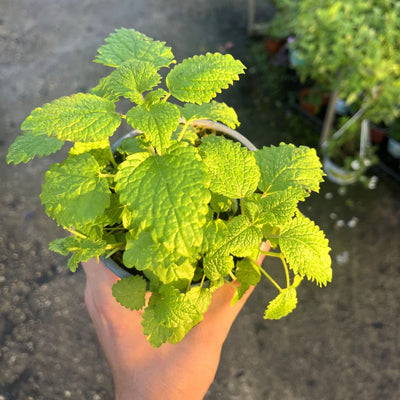
Medicinal Melissa in a pot diameter of 12 cm (perennial)
11.50 ₪
📋 Quick Summary - Everything you need to know at a glance
Full sun to partial shade
In the Israeli summer - partial shade is recommended
Regular, loves moist soil
Do not let the pot dry out completely
Very easy!
Perfect for beginners
Perennial herb
From the Lamiaceae family (like mint)
Approx. 40-90 cm tall
Spreads vigorously in width
🌱 Getting to know the plant
Names and Identification
- Hebrew name: Melissa Refuit (Lemon Balm)
- Scientific name: Melissa officinalis
- English: Lemon Balm
- Family: Lamiaceae (Mint family)
- Type: Perennial herbaceous herb
Origin and Background
Lemon balm originates from the Mediterranean basin and is also a wild plant in Israel: it grows naturally mainly in the Upper Galilee and along streams and damp areas in the north and center of the country, and is rarer in the south and mountainous regions. It is a relative of mint - and for good reason: both spread with the same vigor and in the same way.
Unique Characteristics
- 💪 Hardy and easy to grow - almost impossible to kill
- 🍋 Intense lemon scent when leaves are crushed or touched - hence the name
- 🌿 Spreads vigorously via roots and self-seeding, just like mint
- 🐝 Small, whitish flowers that attract bees and pollinators to the garden
- ☕ Leaves are used for refreshing and relaxing homemade tea
⚠️ Do not confuse: Lemon Balm, Lemon Verbena, and Mint
The name "Melissa" (Melissa officinalis) is sometimes confused with Lemon Verbena (Aloysia citrodora) - an entirely different plant from the Verbena family, which also has a strong lemon scent. And since both are from the Lamiaceae family, it is also easy to confuse lemon balm with mint (Mentha) - both spread aggressively by roots and have wrinkled, textured leaves, but lemon balm smells like lemon and mint smells like menthol. If you bought a seedling without a label, check the smell - it's the simplest way to tell the difference.
💚 Why choose Lemon Balm
🌤️ Detailed growing conditions
☀️ Light
- Full sun to partial shade - a very flexible plant in terms of lighting
- In the hot Israeli summer, partial shade is recommended during the hottest noon hours to prevent leaf burn and overly rapid dehydration
- In winter and spring - the more sun, the more flowering and stronger the scent
- Green-gold leaf varieties (variegata) are more sensitive to direct sun and should be grown in light shade
💧 Watering
Constant moisture in the soil, especially in a pot that dries out quickly in the heat
An established plant in open ground usually makes do with rain; beware of flooding
How to know it needs watering: In a pot - check the top centimeters of the soil with your finger; when they dry out, it's time to water. In open ground, an established plant tolerates slight dryness between waterings.
🌡️ Temperature
Lemon balm is exceptionally cold-hardy and will easily survive the mild Israeli winter. The real risk in winter is not frost but excessively wet and cold soil - this can cause root rot, so good drainage is important even during the rainy season. In the hot summer, it tolerates relatively high heat but prefers some shade during the hottest hours of the day to avoid dehydrating and burning.
🌍 Soil
- Adapts to most soil types - clay, rich soil, and even rocky and relatively poor soil
- The truly important condition is good drainage - swampy soil causes root rot
- Recommended pH range: slightly acidic to neutral (pH approx. 6.0 to 8.0)
🌾 Fertilization
Light, general fertilization once every month to month and a half is quite enough
No fertilization required - the plant is relatively resting and not in active growth
Lemon balm also adapts to relatively poor soil and does not need intensive fertilization - it is a low-maintenance herb that grows well even without extra care.
✂️ Pruning and Maintenance
Harvest young, fresh leaves regularly - ongoing harvesting itself encourages new growth. When the plant begins to bloom, it is worth pruning it down to just above the base - this encourages the emergence of fresh new foliage. If you do not want the plant to seed itself throughout the garden, remove the fading flowers before they have time to ripen into seeds. In the spring, prune the dry stems from the previous season before the new growth emerges.
🌱 Propagation
- Base division: Every few years, in spring or autumn, remove the clump and break it into parts with their own roots, and plant each part separately.
- Stem cuttings: Take a soft cutting in the spring or early summer, and plant in moist soil or in water until rooted.
- Rooting in water: Very easy - simply place a cut branch in a glass of water until roots emerge, then plant in soil.
- Seeds: Relatively slow germination; the plant also tends to self-seed - seeds that fall to the ground germinate on their own the following season.
🔧 Common problems and solutions
🍂 Yellowing or falling leaves
Cause: Usually overwatering or poor drainage.
Solution: Check that the pot drains well, and reduce the frequency of watering.
🌫️ White-powdery layer on the leaves
Cause: Powdery mildew - common in dense foliage with poor ventilation.
Solution: Thin the plant for better ventilation, avoid wetting the leaves while watering, and in severe cases, prune drastically and wait for fresh growth.
🦠 Leaf spots or gray mold
Cause: Excess humidity and poor ventilation around the foliage.
Solution: Improve drainage and airflow, and remove damaged leaves.
🌿 The plant "escapes" and takes over the bed
Cause: Natural and aggressive spread of roots and seeds - this is the nature of the plant.
Solution: Grow it in a pot or container, even if sunk into the ground - this is the simplest way to restrain it.
🐛 Pests
The main pest is leafhoppers. Beyond that, lemon balm is considered relatively resistant to pests and diseases, and usually does not attract deer or rabbits to the garden.
🍵 Additional uses
The leaves are traditionally used for making tea - it's tastiest and most fragrant when the leaves are young and fresh, before the plant blooms, and before drying (drying significantly weakens the scent). Lemon balm is popularly attributed with relaxing properties, and it contains active compounds such as citral and terpenoids. Please note: This is traditional information and not a medical recommendation - consult a doctor before therapeutic use.
❓ Frequently asked questions
Because it spreads vigorously through roots and self-seeding - just like mint, which is in the same family. The simplest solution is to grow it in a pot or container that restricts the roots.
When the leaves are young and fresh, preferably before the plant blooms - this is the stage where the taste and scent are strongest. After flowering, it is worth pruning to encourage new and fresh growth.
There is no fixed number for everyone - the most reliable way is to check the soil with your finger. Keep constant moisture, especially in a small pot that dries out quickly in the summer, and do not let it dry out completely.
Both are from the Lamiaceae family and spread aggressively by roots, but they are completely different types (Melissa vs. Mentha). Lemon balm smells like lemon, mint smells like menthol - the simplest way to tell them apart is to just smell them.
It is primarily a sun-to-partial-shade plant that does best outside - a bright balcony or garden. Indoors, next to a very bright window, you can try, but without enough direct light it will weaken and provide less scent and flavor.
📊 Summary table
| Category | Details |
|---|---|
| ☀️ Light | Full sun to partial shade; in Israeli summer, partial shade is recommended at noon |
| 💧 Watering | Regular, moist soil; less in winter, beware of flooding |
| 🌡️ Temperature | Very cold hardy; susceptible to root rot in wet and cold soil |
| 🌍 Soil | Almost any soil type, good drainage a must, pH approx. 6.0-8.0 |
| 🌾 Fertilization | Light, once every month to month and a half in spring-summer; not in autumn-winter |
| 📏 Size | Approx. 40-90 cm tall, spreads vigorously in width |
| 📊 Difficulty | Very easy - suitable for beginners |
| ✨ Special | Spreads aggressively - grow in a pot; excellent for homemade tea |
🛒 Shop at Deco Garden
🌿 Deco Garden - Love for Plants
Do you have a question about lemon balm or any other plant? The Deco Garden team is here for you - write to us and we will be happy to help.
© 2026 Deco Garden - All rights reserved
The guide was written by the Deco Garden team of experts
🛒 המוצרים מהמדריך
הצמחים והמוצרים שהמדריך מדבר עליהם — לחיצה על כרטיס מעבירה לעמוד המוצר.