🔥 Vriesea | The Complete Guide to Growing and Care
 המוצר מהמדריך זמין באתר
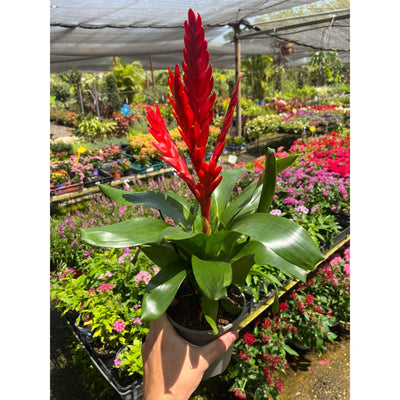
Variegated Rhizome, pot diameter 14 cm (perennial for the home)
88.00 ₪
📋 Quick Summary - Everything you need to know at a glance
Bright indirect light only
No direct sun - it burns leaves and flower spikes
Central cup always full
+ lightly moist soil
Easy-Intermediate
Suitable for beginners
Epiphytic Bromeliad
Pineapple family
Approx. 40-60 cm in pot
Rosette + flower spike
🌱 Introducing the Plant
Names and Identification
- Hebrew name: Vriesea
- Scientific name: Vriesea splendens
- English: Flaming Sword
- Family: Bromeliaceae - Bromeliad family (Pineapple family)
- Type: Tropical epiphyte; grows naturally hanging on tree trunks in rainforests
Origin and Background
Vriesea originates from the tropical rainforests of South America - from eastern Colombia to Trinidad and Tobago. In the wild, it is an epiphyte: a plant that grows hanging on high tree branches rather than in the ground, absorbing a significant portion of its water and nutrients directly through its leaves and central cup, rather than just through its roots, whose primary role is only anchorage.
Unique Characteristics
- 🏆 Leaf rosette that forms a natural "cup" in the center - stores water just like in the wild
- 🔥 Flat and colorful flower spike (red/orange/yellow) that stays beautiful for months
- 🌬️ Shallow roots used mainly for anchorage, not primary water absorption
- 🌸 Blooms once in its life and then slowly fades, but leaves behind new "pups"
- 💨 Absorbs water and nutrients through leaves and cup, not just the soil
- 🎨 Huge variety of shades on the market - red, orange, yellow, pink, and burgundy
🤔 Note - Name Confusion
In recent years, botanists have reclassified some Vriesea species under the scientific name Lutheria splendens (for example, according to the NC State Extension database), but in the horticultural world, nurseries, and commercial websites, everyone continues to use the long-standing and well-known name Vriesea - it is the exact same plant, just an updated scientific name. Additionally, "Vriesea" is used in the market as an umbrella term for several varieties and related hybrids in the same family, all having a similar structure of a leaf rosette with a flat flower spike, sold in various shades.
💚 Why Choose Vriesea
🌈 Varieties and Types
The "original" variety (Vriesea splendens) with a striped red-orange spike, from which most commercial hybrids evolved
Dense green leaf rosette with an intense, branching red flower spike - common in nurseries
Flower spike in a light yellow shade - very refreshing for bright spaces
Commercial hybrids in shades of red, orange, pink, and burgundy
🌤️ Detailed Growth Conditions
☀️ Light
- Bright but indirect light only - direct sun burns leaves and fades the intense spike color
- Ideal location: Near an east or south window but not right against it, or a few meters from a southwest window; a sheer curtain can also be used to filter light
- Varieties with dark green leaves need less light and suffer more in shade; varieties with variegated or silver leaves need more light
💧 Watering
The most important feature in bromeliad care: fill the central cup (the rosette in the middle) with soft water or rainwater, and keep it filled at all times.
Cup always full, fresh water every 1-2 weeks; soil lightly moist, not soaking
Reduce cup refilling and soil watering frequency, but do not let it dry out completely
How to check: It is important to empty and refill the cup with fresh water every 1-4 weeks to prevent salt buildup and stagnant water. A soft, brown base = overwatering in soil. Wilting leaves and bone-dry soil = not enough water.
🌡️ Temperature
Comfort range: approx. 18–27°C. Vriesea is a quintessential tropical houseplant and is sensitive to frost - avoid temperatures below 10°C. In summer, it can be kept on a shaded balcony protected from hot, dry wind, but in winter - especially in cold mountainous areas - it must be brought inside.
💦 Humidity
Bromeliads love high air humidity - about 50-70%. Indoor heating and air conditioning dry out the air. It is recommended to increase humidity using a pebble tray with water under the pot, misting the air around the plant, or grouping it with other plants.
🌍 Soil
- Well-draining epiphytic mix: Orchid potting mix / pine bark + perlite + a little regular potting soil
- Excellent drainage is the most important requirement - in the wild, the roots barely absorb water, they only anchor the plant
- Pot with active drainage holes and a saucer that doesn't collect standing water - critical for preventing rot
🌾 Fertilization
Balanced liquid fertilizer, diluted to one-quarter or half of the recommended concentration, every 4-6 weeks - directly into the central cup or sprayed lightly on leaves
Stop or significantly reduce fertilization during the cold season when the plant is dormant
✂️ Routine Maintenance
- Empty and replace water in the central cup occasionally to prevent odor and stagnant water
- Wipe dusty leaves gently with a damp cloth
- Remove brown or dry leaves at the base of the plant gently
- When the spike fades and the mother plant begins to wither - this is natural behavior; it is recommended to leave the new pups to develop around it, and trim the dry flower stalk only when it is completely brown
🌱 Propagation
The easiest and most common way to propagate Vriesea is through the pups the mother plant produces around its base towards the end of its life - much simpler than propagation from seeds.
- Wait for the pup to reach about one-third the size of the mature plant
- Separate it gently from the base of the mother plant, using a clean and sharp knife, with a few roots if any
- Plant in a well-draining epiphytic mix, similar to the mature plant, in a small pot
- Keep high humidity and indirect light in the first few weeks, until rooting
- The new pup will bloom itself only after several years (approx. 3-5 years)
🔧 Common Problems and Solutions
🍂 Brown leaf tips
Symptom: Brown and dry tips/edges.
Cause: Water with high mineral content ("hard" water) or too low air humidity.
Solution: Use rainwater or filtered water and increase ambient humidity.
🦠 Base rot
Symptom: Base of the plant is soft, brown, and smelly.
Cause: Excess water in soil or standing water at the bottom of the pot.
Solution: Empty excess water, reduce soil watering, and ensure proper drainage.
💛 Leaves yellowing slowly
Symptom: Entire plant yellows gradually, usually after flowering.
Cause: This is natural aging - the mother plant fades slowly after flowering.
Solution: Let the new pups develop; if this happens without flowering, check light conditions.
🎨 Spike losing color
Symptom: The intense color of the spike fades.
Cause: Overexposure to direct sun.
Solution: Move to a bright spot without direct sun.
🐛 Pests
Common pests in Vriesea are scale insects, mealybugs, and sometimes spider mites in overly dry air. Treatment: Wipe leaves with a damp cloth and use insecticidal soap, while avoiding spraying directly into the central cup.
❓ Frequently Asked Questions
The cup should stay filled with soft water or rainwater at all times. It is recommended to empty and refill with fresh water every 1-4 weeks to prevent salt buildup.
This is natural and normal behavior. Every Vriesea blooms once in its life, then the original leaf rosette fades slowly as the plant produces new "pups" at its base.
Wait until the pup is about one-third the size of the parent plant, then gently separate it from the base with some roots and plant in a well-draining mix.
In summer, yes, on a shaded balcony protected from hot winds. In winter, bring it indoors as it is sensitive to cold.
Usually a sign of mineral-rich water ("hard" water) or low humidity. Switch to rainwater/filtered water and increase humidity.
📊 Summary Table
| Category | Details |
|---|---|
| ☀️ Light | Bright and indirect - no direct sun |
| 💧 Watering | Central cup full + lightly moist soil |
| 🌡️ Temperature | 18–27°C, not below 10°C |
| 💦 Humidity | High, about 50-70% |
🛒 Shop Deco Garden
🌿 Deco Garden - Love for Plants
Do you have a question about your Vriesea or any other plant? The Deco Garden team is here for you - write to us and we will be happy to help.
© 2026 Deco Garden - All rights reserved
The guide was written by the Deco Garden expert team
🛒 המוצרים מהמדריך
הצמחים והמוצרים שהמדריך מדבר עליהם — לחיצה על כרטיס מעבירה לעמוד המוצר.