Monstera Deliciosa at home: light, watering, pole, and pot
 המוצר מהמדריך זמין באתר
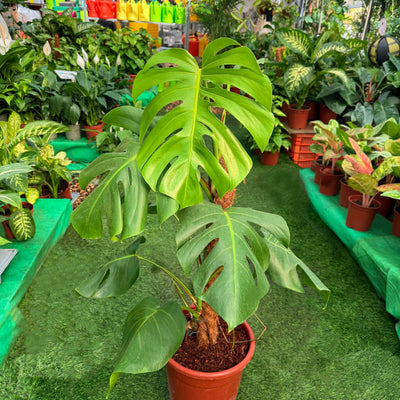
Monstera, pot diameter 24 cm (10 liters) (perennial for the home)
175.00 ₪
Monstera deliciosa is a large tropical climber, not a tabletop plant that stays the same size. Proper care starts with bright, indirect light, checking the soil before watering, space for leaves, and sturdy support. This guide was written specifically for Deco Garden’s Monstera in a 24 cm / 10-liter nursery pot, which comes with a coir totem included.
The first week at home: Stability before changes
- Choose a permanent spot: Bright indirect light, away from direct air conditioning drafts and direct afternoon sun through glass.
- Check before watering: Do not assume the plant is thirsty because of shipping; check the soil depth.
- Keep the nursery pot: Do not repot immediately unless there is a drainage issue, damage, or clear overcrowding.
- Let the leaves adjust: A slight shift in angle or a leaf leaning after transport is not a reason to fertilize or water again.
Light and placement: Bright, filtered, and spacious
The RHS recommends bright, indirect or filtered light and stable indoor temperatures. In Israel, it is best to start near a bright window behind a sheer curtain or at a distance where there is no direct afternoon sun on the leaves. Rotate the pot occasionally so the plant doesn't lean entirely in one direction, but avoid changing its location daily.
Monsteras can survive in lower light, but slow growth, long petioles, and small leaves may indicate a light deficiency. Strong sun without acclimation can burn the foliage. The plant is large and continues to climb, so leave room above and around it, and do not press the leaves against a hot wall.
Watering and drainage: The soil condition determines when
NC State describes thorough watering after the top quarter to third of the soil has dried out. This is a more useful indicator than a fixed schedule: in a bright summer, the soil may dry out faster, while in winter or a cool room, it will dry more slowly.
- Check at several points using a finger or a wooden skewer, deeper than the surface layer.
- If the top quarter of the soil is still moist, wait and check again later.
- When the top quarter to third is dry, water slowly around the entire surface of the soil.
- Allow water to drain from the drainage holes and empty the saucer or decorative pot.
Yellow leaves can appear for various reasons, so do not water automatically in response to one leaf. First, check if the soil has been wet for too long, if the drainage holes are clear, and if there has been a sudden change in light or temperature.
Soil and fertilization
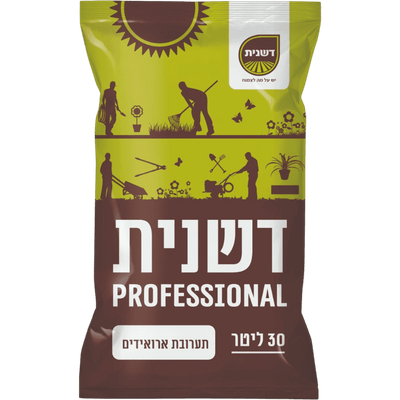
The goal is a mix that holds some moisture but allows for airflow and drainage. Deco Garden's aroid mix is sold in 30-liter bags and is relevant when it is time to repot; there is no need to immediately replace the soil the plant arrived in.
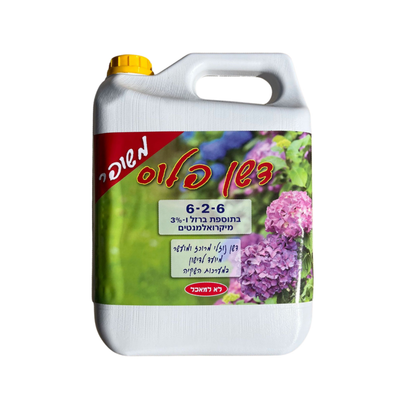
Fertilize only during active growth and strictly according to the product label. 6-2-6 fertilizer comes in a 5-liter container, making it more suitable for those caring for multiple plants. Fertilizer does not fix overwatering, lack of light, or roots that remain wet.
Coir totem, aerial roots, and perforations
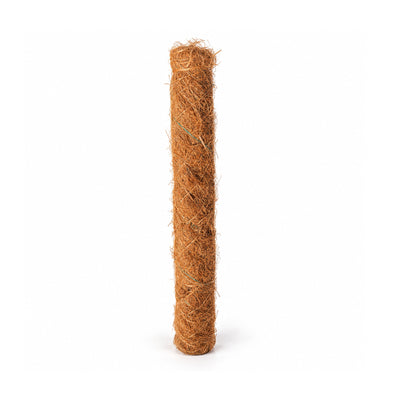
In nature, the Monstera is a climber. The coir totem included with the product provides direction and reduces sprawling, but it does not immediately change the size of the leaves. Position the main stem against it and tie it with a soft, loose strip. Do not tie the petiole—the arm connecting each leaf to the stem—as it needs to move and turn toward the light.
Aerial roots can be gently directed toward the totem or the soil; do not force a rigid root to bend at a sharp angle. Check monthly to ensure the ties are not tight and the totem remains stable.
Perforations and splits are not guaranteed. Young leaves may emerge solid. The maturity of the plant, sufficient light, and stable growing conditions influence leaf shape; there is no quick treatment that forces a new leaf to open with a specific number of perforations.
When to repot a Monstera from a 24 cm pot?
The University of Minnesota Extension notes practical signs for repotting: roots growing out of the drainage holes, soil drying out within about 24 hours, the plant tipping over easily, a dense root ball, or growth that has stalled for no other reason. The fact that the plant is sold in a 24 cm pot does not mean it needs to be repotted immediately.
When repotting is actually needed, choose a container slightly wider than the root ball. The rule of thumb of adding about 2.5–5 cm provides a check point of about 27–29 cm, but the diameter of the nursery pot is a nominal measure, and the root ball may be narrower. Measure before ordering.
Mobile: Swipe the table to the sides to see all columns.
| Goal | What to measure | What to choose |
|---|---|---|
| Keep in nursery pot | Drainage, stability, and drying rate | Do not change pots if there are no signs of overcrowding |
| Decorative cover pot | Diameter of the rim and base of the nursery pot, and its height | Inner opening diameter, inner base diameter, and internal depth slightly larger than the measured dimensions |
| Repotting | Diameter and depth of the root ball after careful removal | Pot with a drainage hole, 2.5–5 cm wider than the root ball |
| Check size 27–29 cm | All internal dimensions of the container, not just the title | A starting point only for a plant needing repotting; not a guarantee of fit |
Propagation
Regarding propagation, a leaf or petiole alone will not create a new plant. The University of Minnesota Extension emphasizes that a cutting must include a node on the stem, from which new growth can develop.
What is shown in the video?
To see the product actually sold, look at the first image in the gallery: a real photograph in the nursery of the plant in a 24 cm pot with the coir totem included.
Common signs and what to check
- New leaf without perforations: Check age and light; young leaves can be solid.
- Brown edges: Check for uneven watering, salt buildup, heat, or very dry air; do not assume a single cause without checking.
- Yellow leaf and wet soil: Check for standing water, drainage, and watering frequency before adding water.
- Plant leaning to one side: Check the stability of the totem, adjust the main stem, and rotate the pot slightly relative to the light.
- Roots outside the pot: Check the root ball and drying rate; a single root is not always a reason for immediate repotting.
Shopping list by need
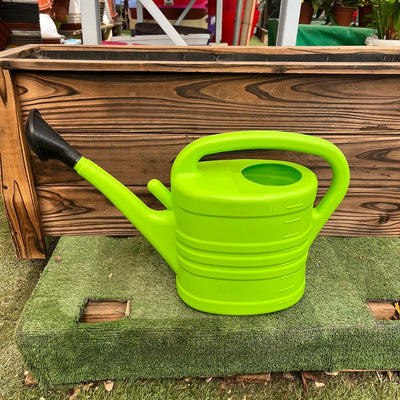
Watering Can
Helps water slowly and evenly. Choose a volume that is comfortable to carry; there is no need to automatically choose the largest one.
Select volume and colorAroid Mix 30L
For repotting only when there are signs of overcrowding or soil issues. The large bag is not a mandatory purchase the day the plant arrives.
Mix details6-2-6 Fertilizer, 5L
For active growth only and according to the label. The volume is mainly suitable for a home or balcony with multiple plants.
Fertilizer detailsFrequently Asked Questions
How often to water a Monstera deliciosa?
There is no fixed number of days. Check the depth, water when the top quarter to third of the soil is dry, and empty all excess water.
When to repot a Monstera from a 24 cm pot?
Only after signs of overcrowding, poor drainage, drying out within about 24 hours, or instability. A 27–29 cm internal container is a starting check point only, after measuring the root ball.
Is an additional totem needed?
Not at the beginning. The product comes with a coir totem included. Check that it is stable and tie only the main stem to it with a soft tie.
Why does the new leaf have no perforations?
Young leaves can be solid. Perforations depend on maturity and growing conditions and are not guaranteed in every new leaf.
Does the video show the plant I will receive?
No. It is a licensed demonstration video of a mature plant. The first image in the gallery is a real photo of the product in the nursery, and there is natural variation even among living plants.
Professional Sources
🛒 המוצרים מהמדריך
הצמחים והמוצרים שהמדריך מדבר עליהם — לחיצה על כרטיס מעבירה לעמוד המוצר.